
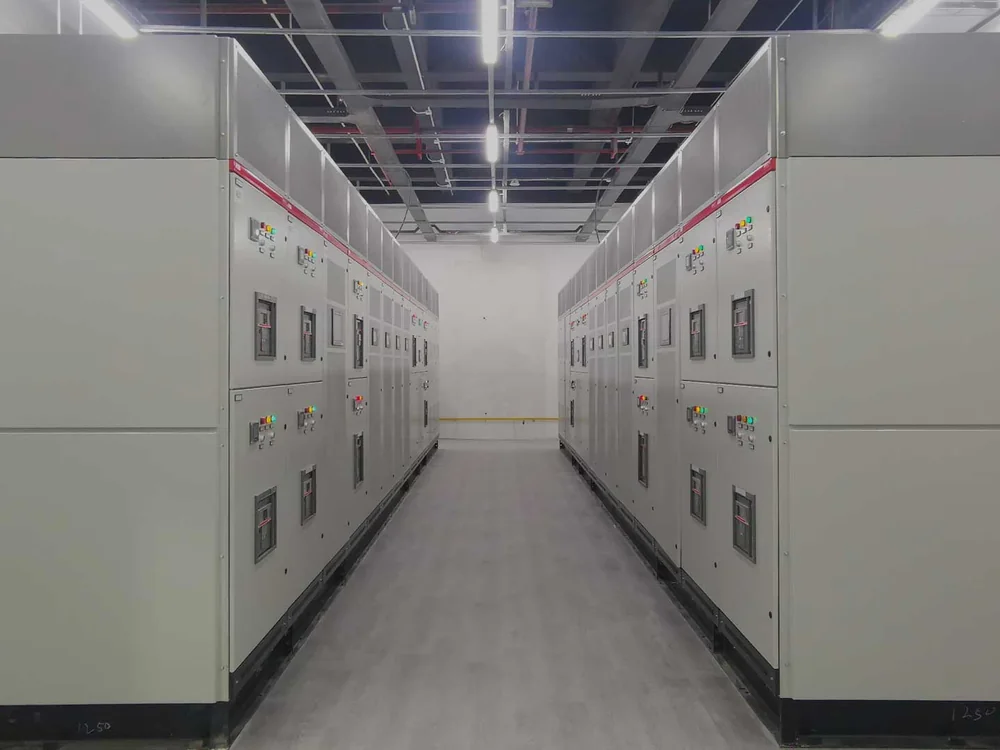
Most DC panel quotations are not rejected on price. They are returned because the 220 V DC panel datasheet that came with them is a catalogue page: it lists a voltage, an ampere rating and a cabinet size, and leaves the project conditions unstated. Protection and tripping schemes in substations, mine switchyards, railway traction substations and telecom power rooms all run on a DC bus that has to stay alive when the AC feed disappears. On civil infrastructure projects, that is the whole job of the panel. This note is about reading the datasheet the way the EPC's reviewer reads it, line by line, before the drawing stage starts.
The 7 lines an EPC auditor reads
A substation dc system is four things in one cabinet: a charger (rectifier modules), a battery string, a DC distribution panel and a monitoring unit. Catalogue structure in the industry reflects that split — charging modules, DC systems, AC/DC integrated panels, central signal panels and distributed DC units are usually listed as separate items even when they ship in one cabinet. Read the datasheet as a system description, and check that each of the seven lines below carries a project-specific value rather than a range copied from a brochure.
| Line | Typical catalogue value | What the reviewer wants stated |
|---|---|---|
| 1. Bus voltage | 110 V or 220 V DC | Site standard, tolerance band, insulation level of the bus |
| 2. Charger | 20–300 A, float / boost, 10 h recharge | Module model, N+1, current sharing, derating curve at site ambient |
| 3. Battery | 20 / 38 / 65 / 100 / 200 / 400 Ah | Load list, autonomy in hours, ageing and temperature factors, VRLA or Ni-Cd |
| 4. Distribution | 2-pole MCB feeders, graded, 20 % spare ways | Feeder count and ratings, selectivity study, spare ways, gland plate |
| 5. Monitoring | Bus voltage, battery current, AC fail, earth fault, breaker status | Alarm list, dry contacts or Modbus register map, per-block battery supervision |
| 6. Power quality | < 1 % ripple at float voltage | Test point and load condition for the ripple figure, insulation monitoring threshold |
| 7. Environment | −25 to +55 °C, derate above +45 °C; IP30 / IP54 | Ambient at the cabinet location, sunshade and filter, cable entry, standard applied |
Values in the middle column are the frame range we quote on our 220 V DC panel page. They are starting points, not a completed specification.
1. Nominal voltage is a system decision, not a component choice
220 V DC and 110 V DC are substation control and tripping voltages. 48 V DC belongs to telecom rectifier systems, and 24 V DC belongs to control panels and machine builders. A 220 V DC panel datasheet has to name the DC bus explicitly: "220 V AC input" and "220 V DC output" are different lines, and mixing them in a bill of materials is a common reason a bid gets flagged. The site standard decides the nominal voltage; the number of protection panels and feeder lengths decide the voltage drop, not the other way round. If the same project also needs panel-level 24 V supplies, keep them as a separate line — see DIN-rail PSU and off-grid telecom DC. Do not try to derive one from the other with a converter inside the tripping chain.
2. Charger current and N+1: read both numbers
The charger has to carry the continuous load and recharge the battery inside the stated window. A usable first pass for a 10-hour recharge is Icharger = Iload + (CAh × 1.2) / 10 h. For a 5.5 A continuous load and a 100 Ah battery that is 5.5 + 12 = 17.5 A, so a 20 A module is the next standard size. N+1 then means two 20 A modules: with one out of service, the remaining module still carries 17.5 A. A datasheet that says "N+1" without the module rating has told you nothing — the redundancy only exists if one module alone covers the full calculated current at the site's maximum ambient.
Ask for four things with the module line: the model number and its derating curve, whether modules are hot-swappable, how current sharing behaves with one module removed, and which protocol the monitoring unit uses to report module status. Modular construction is standard across industrial UPS and DC systems; the reviewer is checking the failure case, not the marketing word. Temperature compensation on float voltage belongs on the same line, because a battery charged at a fixed float voltage in a +50 °C room will not reach its design life.
3. Battery Ah without the load list is marketing
Capacity in ampere-hours is only meaningful against a load profile and an autonomy requirement. Worked example: 1.2 kW of continuous protection and control load on a 220 V DC bus, 2 hours of autonomy.
- Continuous current: 1200 W / 220 V = 5.45 A
- Charge required: 5.45 A × 2 h = 10.9 Ah
- Apply 1.25 ageing and 1.20 design margin: 10.9 × 1.25 × 1.20 = 16.4 Ah
- Divide by 0.8 usable depth of discharge: 20.5 Ah
- Select the next standard frame above that figure — 38 Ah, not 20 Ah — and go one frame further up if the battery bay sits at +45 °C or above.
Two checks sit outside that arithmetic. Intermittent loads such as spring-charging motors and closing coils are a peak-current check, not an average to fold into ampere-hours. And a series string is only as good as its weakest block: a 220 V string is commonly 18 × 12 V blocks (≈216 V nominal) and a 110 V string 55 × 2 V cells, so ask the supplier whether the monitoring unit measures per-block voltage and battery ambient temperature over RS-485, or only the total string voltage. Total voltage alone will hide a failing block for months.
4. Distribution, grading and spare ways
This is where a DC panel specification usually fails review. Outgoing feeders need protection grading so a fault on one tripping coil does not drop the whole bus. State the number of feeders, each rating, the 2-pole MCB curve, and the selectivity study that backs the grading. We quote 20 % spare ways as standard, because the next retrofit should not require a new cabinet. Cable entry is decided before the cabinet is built: confirm gland plate positions against the incoming cable schedule, keep AC and DC wiring in separate internal routes, and size the earth bar for the largest prospective fault rather than for load current. At first energisation, check float voltage on every feeder before closing the breakers and log the initial battery capacity — that number is the baseline for every later capacity test.
5. Ripple, insulation monitoring and the alarm list
A ripple figure such as < 1 % at float voltage only means something when the test point and load condition are named. On an unearthed (IT) DC bus, insulation monitoring matters as much as voltage monitoring: the first earth fault must be reported, not discovered during a trip failure. Get the alarm list in writing — bus over/under-voltage, battery current, AC input failure, earth fault, breaker status, module failure — and how it leaves the cabinet. Dry contacts suit a simple RTU; a Modbus RTU register map suits a SCADA integration. Protection and substation automation teams care about this list, because an alarm that never reaches the control room is not an alarm. If the datasheet offers only "remote monitoring optional", put the protocol and the point list into the RFQ.
6. Derating, enclosure and the documents attached to the bid
The published −25 to +55 °C range is not a licence to install a cabinet in an unshaded compound at +55 °C without correction. Derating normally starts above +45 °C, and a hot battery bay loses life faster than it loses capacity. For desert sites, read 55 °C + dust + no grid and desert substation configuration; for high sites, the cooling margin sets the frame size regardless of the electronics — see power derating at 4000 m. IP30 is an indoor cabinet rating; IP54 with filter and sunshade is a different build with a different thermal budget.
Finally, name the standard on the line with the product: DL/T 459 and GB/T 19826 are the usual references for DC power supply equipment in power plants and substations. Attach the per-model certificate, the type test report, the single-line diagram, the battery calculation and the charger datasheet. A blanket "CE compliant" line does not replace a model-specific document; our certification scope page explains the difference, and the procurement FAQ covers warranties, MOQ and lead times.
RFQ checklist: send this instead of a one-line enquiry
- Single-line diagram with the outgoing feeder count and ratings
- Load list in watts, split into continuous and intermittent loads
- Autonomy required in hours at that load
- Nominal DC bus voltage (220 V / 110 V) and the site standard
- Ambient temperature range and cabinet location, indoor or outdoor
- Battery type (VRLA default or Ni-Cd) and whether per-block supervision is required
- Alarm interface: dry contacts or Modbus RTU, with the point list
- Required spare ways, spares and the documents that must travel with the bid
Send those eight lines and you get a cabinet drawing, a battery calculation and a charger datasheet back, instead of a catalogue page. Open the DC power system selector for a first pass, or send the load list to our Beijing desk for a spec review. Related notes: EN 50155 vs industrial PSU · rugged UPS specifications · all technical notes.