
Industrial UPS for Mining and Substation Sites
Industrial UPS battery backup, 10–200 kVA frames, outdoor UPS enclosures, UPS 48 V DC options, separable battery compartments, −40 to +55 °C
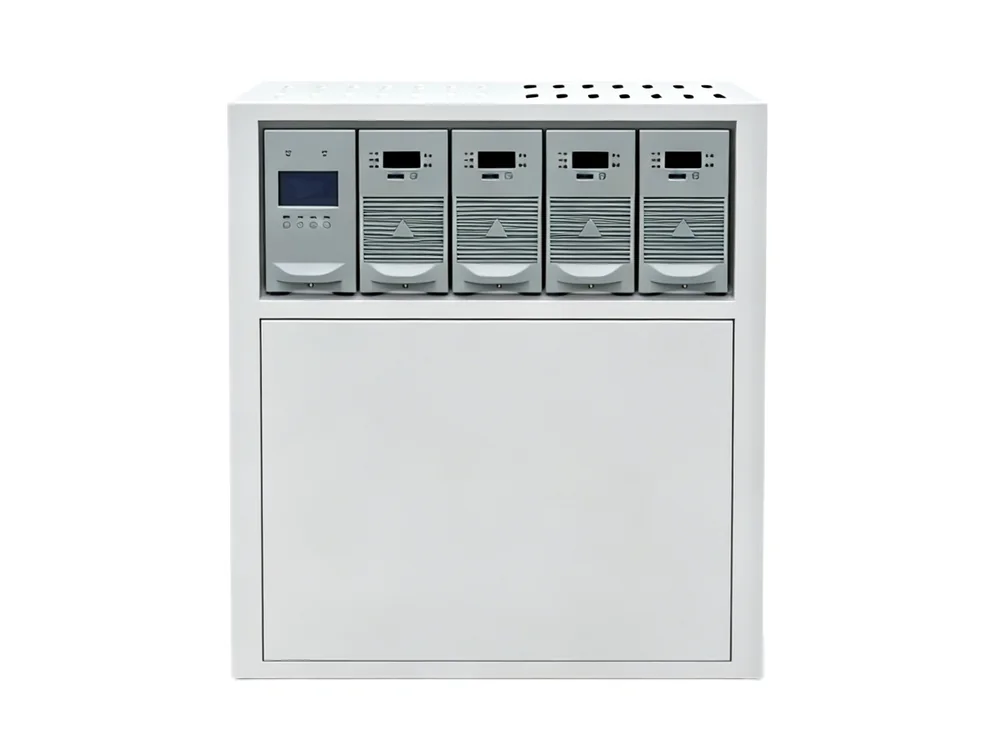
An industrial ups battery backup on a mine dewatering panel or a substation SCADA cabinet has one job: hold the load until the generator picks up. Everything else — kVA rating, topology, brand — is downstream of that.
What an industrial ups battery backup has to survive on site
The four stresses that kill an industrial ups in the field are heat, cold, vibration and dirty input power. Heat shortens battery life to nothing: a sealed lead acid battery that delivers 10 years at 25 °C delivers about 5 at 35 °C and about 2.5 at 45 °C. Cold does the opposite — at −30 °C the same battery gives roughly 40–55 % of its rated capacity, which is why a winter start at 4000 m needs a heated or indoor battery compartment rather than a bigger battery.
Vibration is the one buyers forget. On a movable crusher or a rolling platform, plate growth and terminal loosening show up within a year. We quote bolted terminals and a restrained battery tray as standard, not as an option.
Input power on a mine or a remote substation is neither clean nor stable: 300–480 V swings, 5–8 % THD, and a diesel genset that hunts under load steps. A DC UPS on the same site sees the same bus through a charger, so the charger has to tolerate the same range.
Highlights
- 10–200 kVA in nine frame sizes on one double-conversion platform, so spares and commissioning procedures carry across the range.
- 0 ms transfer with bypass under 2 ms, measured at the output terminals and recorded on the acceptance test report.
- −40 to +55 °C continuous, with the battery compartment rated separately so a hot cabinet does not cook the string.
- IP31 as standard, IP42 with the filter kit and IP54 on request — all quoted as part numbers, not as field modifications.
- Bolted battery terminals and a restrained battery tray as standard, vibration tested 5–500 Hz per IEC 60068-2-6.
- Parallel operation up to 8 frames, with load-bus synchronisation on the 100 kVA and 200 kVA cabinets.
Frame range
| Model | Output | Input | Configuration |
|---|---|---|---|
| RU-10 | 10 kVA / 8 kW | 1-ph 220–240 V | Wall or 19" rack, internal battery |
| RU-30 | 30 kVA / 24 kW | 3-ph 380–415 V | Cabinet, external battery |
| RU-50 | 50 kVA / 40 kW | 3-ph 380–415 V | Cabinet, separable battery drawer |
| RU-100 | 100 kVA / 80 kW | 3-ph 380–415 V | Cabinet, parallel up to 8 units |
| RU-200 | 200 kVA / 160 kW | 3-ph 380–415 V | Cabinet, parallel with LBS |
Specifications
| Parameter | Value |
|---|---|
| Frame sizes | 10 / 15 / 20 / 30 / 50 / 80 / 100 / 150 / 200 kVA |
| Topology | Double conversion online, DSP control |
| Input | 380/400/415 V AC 3-ph, 50/60 Hz, −40 % to +25 % rectifier window (not an EN 50155 supply class) |
| Battery | 48 V DC string on the small frames, 192 V / 384 V DC on the larger ones, VRLA or LiFePO4 |
| Autonomy | 15 min to 8 h at full load, sized per load list |
| Operating temperature | −40 to +55 °C (battery compartment separately rated) |
| Ingress protection | IP31 cabinet, IP42 with filter kit |
| Transfer time | 0 ms, bypass < 2 ms |
| Monitoring | RS-485 / Modbus RTU, dry contacts, SNMP card option |
The battery decides ups runtime, not the kVA rating
ups runtime is a battery question. Two 100 kVA units with the same load can differ by a factor of six in runtime purely on battery sizing, and the honest way to quote it is from your load list in watts, not from a kVA guess. A sealed lead acid battery string is the default: cheap per watt-hour, maintenance-free, and predictable between −15 and +45 °C. LiFePO4 wins where the cabinet runs hot or the site is visited rarely — roughly double the cycle life and half the volume, at about 2.5× the price.
What we will not do is quote an industrial ups runtime we cannot show on a discharge test. Every ups battery backup frame ships with a measured capacity curve at 25 °C and a derated curve for your site temperature.
Standards the frame is built and tested to
- IEC 62040-3 — classification and performance test method
- IEC 62040-2 — EMC, class C2 for industrial locations
- GB/T 7260 — Chinese national equivalent, tested in parallel
- Vibration per IEC 60068-2-6, 5–500 Hz, on the battery tray
- Optional EN 50155 variant for rolling-stock applications
Battery installation and commissioning
The battery string is where a commissioning goes wrong. Torque the terminals to the value on the label — under-torqued terminals heat, over-torqued ones crack the post. Record the initial float voltage of every block; that record is what tells you eighteen months later whether a block is failing or the charger is misadjusted. A first discharge test at 25 °C, logged against the delivered curve, settles any argument about capacity before the warranty period starts.
Documents delivered with the order
- Acceptance test report — the routine tests from IEC 62040-3 with measured values, not a blank certificate.
- Battery discharge curve at 25 °C, plus the same curve derated to your site temperature.
- Wiring and terminal schedule with battery torque values and the recommended breaker and cable sizes.
- Commissioning checklist for the first energisation, in the order the steps have to happen.
These ship with the unit as part of the order. If your project needs a full type-test report for a named standard, say so at quotation stage and we will tell you what the factory can release.
Send us the numbers
Send the load list in watts, the autonomy you need in minutes and the site temperature range. You get a frame, a battery string and a runtime curve derated to your site.
Standards referenced on this page
- IEC 62040-3 — Uninterruptible power systems — method of specifying the performance and test requirements
- IEC 62040-2 — EMC requirements for UPS above 1 kVA
Frequently asked questions
QHow do I size an industrial ups for a site at 4000 m?
Work from the load in kVA and the minutes you need to ride out, then derate twice: once for altitude, because thinner air removes less heat, and once for ambient temperature. A 100 kVA load at 4000 m and 45 °C is not a 100 kVA industrial ups. Send the load, the altitude, the ambient range and the required autonomy, and the frame and the battery string get sized together rather than separately, and the ups runtime comes out derated rather than nominal.
QWhich industrial ups platform should a harsh site use?
Three bands, and the band decides the document trail rather than a quality verdict. Tier A is the international platform with a global service network and the longest document trail. Tier B is the Chinese first-tier platform, which is where most of our harsh-environment work sits, including every DC UPS cabinet we ship. Tier C is a cost-driven general-purpose platform that we will not offer for a −40 °C or a 4000 m site. Each band differs in interface drawings, certificate set and lead time, so the comparison has to be made per project.
QHow long should the ups runtime be?
Long enough for your defined event, and no longer. On a mine or a substation that is usually 15 to 30 minutes at full load — enough to transfer to a generator or to shut down in a controlled way. Autonomy costs more in the sealed lead acid battery string than in converter capacity, and at low temperature the battery is the first thing to shrink, so size against the coldest expected ambient rather than the nominal figure, and ask for the ups runtime at that temperature.
QCan a standard DC UPS run at −40 °C?
Not without changes. The electronics will usually start; the battery string will not. At −40 °C a sealed lead acid battery holds a small fraction of its rated capacity and will not accept charge properly. The usual answers are an insulated battery enclosure with thermostatic heating, or a lithium pack with its own low-temperature charge cutoff. Both have to be in the original inquiry, not added after the order.
QDo I need an ATS, and which type?
If you have two sources and a load that must not see a break, yes. A static transfer switch moves in a few milliseconds and suits electronic loads. A contactor-based unit is slower but far more robust and much cheaper, and it suits motor and heater loads where a short break is harmless. Manual changeover is fine where an operator is present and the outage window is acceptable. Whichever type you choose, it sits downstream of the industrial ups, not inside it.
QWhat is the typical lead time for an ups battery backup package?
Four to eight weeks for a standard frame in the 10 to 200 kVA band. It extends if the sealed lead acid battery string is a non-standard voltage, if the enclosure has to be IP54 or better, or if the order lands in the Chinese New Year window. Custom battery enclosures and third-party witness testing are the two items most likely to push a date out, and both are worth deciding on early.
Size the UPS on derated output, not on the nameplate
Give the configurator the load in kVA, the altitude, the ambient range and the minutes you need to ride out. It returns the frame and the battery string sized together, with altitude and temperature derating already applied, which is the same arithmetic the quotation is built on.