
Custom Power Supply and Non-Standard Units
Custom power supply built to drawing, from 20 units; a custom dc power supply or modular power system, with the mechanical and electrical interfaces defined before production
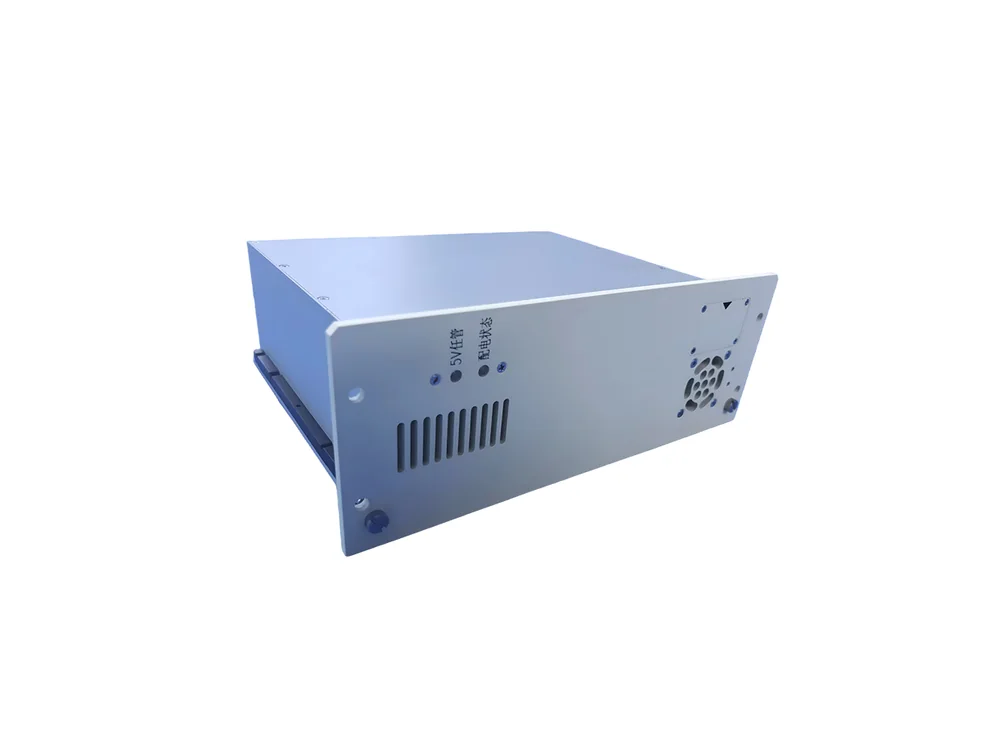
Custom work is a documentation exercise before it is a manufacturing exercise. A custom power supply that arrives and does not fit the cabinet is worse than a standard unit that is slightly too big.
When a custom power supply beats a standard frame
The arithmetic that decides it: a standard industrial power supply that needs a 30 % derate, an external enclosure, a custom mounting plate and a fan retrofit usually costs more than a purpose-built unit at the same rating — and it arrives with three extra parts to fail.
We quote custom from about 20 units. Below that the documentation cost per unit dominates; above it, tooling is amortised and the price lands within 10–25 % of a standard frame with none of the compromises.
What the range is built from
Most custom units are not designed from scratch. We build them from modular power supply blocks — a charger module, a dc/dc converter, a distribution module and a monitoring card in a cabinet or chassis sized to your envelope. The advantage is that each block already has a test history, so the custom part is the cabinet and the wiring, not the power stage.
A modular power supply approach also makes the field service story simple: a failed module is swapped in minutes without breaking into the cabinet wiring.
What a frozen specification contains
| Parameter | Value |
|---|---|
| Input | Voltage range, phase, frequency, inrush limit |
| Output | Voltage, current, regulation, ripple, transient response |
| Environment | Temperature range, altitude, humidity, ingress protection, vibration |
| Mechanical | Envelope drawing, mounting, connector type and position, cable entry |
| Cooling | Conduction plate, forced air, or sealed with derating |
| Protection | Over-current, over-temperature, under-voltage lockout, output crowbar |
| Monitoring | Signals provided: voltage, current, status, alarm |
| Documentation | Schematic, bill of materials, test procedure, acceptance test report |
How a custom order runs
- Week 1 — your drawing, load list and site conditions reviewed; specification frozen in writing
- Week 2–3 — mechanical drawing and schematic for your approval
- Week 4–8 — build, routine tests, 100 % burn-in at full load
- Week 9–14 — acceptance test report, datasheet and spares list, packing, shipping and export documents, then delivery
First article inspection and acceptance
Every custom build gets a first article before the run starts. We test it against the frozen specification: input range sweep, output regulation at 25 / 50 / 75 / 100 % load, ripple, transient response to a load step, protection operation, and a full-load burn-in. The report and the photographs go to you before the remaining units are built, so any correction is made once rather than twenty times.
When the answer is a DC system instead
If the requirement is battery backup with charging, distribution and alarms, the right product is a DC system with a custom distribution section rather than a bare custom power supply. Same process, different bill of materials.
Send us the numbers
Send the envelope drawing, the load list and the site conditions. You get a frozen specification and a first-article plan before anything is built.
Standards referenced on this page
- IEC 62368-1 — Audio/video, information and communication technology equipment — safety requirements
- IEC 61000-6-2 — EMC immunity standard for industrial environments
Frequently asked questions
QWhat do you need before you can quote a custom power supply?
Either a single line diagram with the electrical specification, or a mechanical drawing with the envelope and the mounting, plus: input and output voltages and power, the temperature range and the site altitude, the cooling arrangement, the approvals you need, the quantity and the date. A sketch with those seven items is enough to start. A paragraph of prose describing the idea is not.
QWhat is the minimum quantity for a custom power supply?
Typically 20 to 50 units, depending on how far the design departs from an existing platform. Below that, the non-recurring engineering and the tooling dominate the unit price. If you need five of something unusual, it is usually better to find the closest modular power supply and adapt the installation around it. We will tell you which way your case falls before you commit.
QHow long does a custom design take?
Ten to fourteen weeks from a frozen specification to first articles, plus qualification testing where it is required. Two things reliably extend this: a specification that keeps changing during design, and a test programme that is only agreed after the units have been built. Freeze the electrical specification before tooling starts, and agree the test plan in the same week.
QWho owns the design?
You own the drawing package that was produced for you and we hand it over. The manufacturer retains their platform intellectual property, their tooling and their process know-how, which is normal for custom work. If you need the industrial power supply design to be portable to a second source, say so at the beginning — it changes how the documentation package is assembled and what the tooling costs.
QWhat can you not customise?
We cannot change physics. A dc system that has to run at −40 °C needs its batteries inside the thermal envelope, and no drawing changes that. A given enclosure volume dissipates what it dissipates. A battery chemistry has the low-temperature behaviour it has. A safety approval cannot be backdated onto a design that was not built to it. Where a request asks for a rating that the enclosure or the chemistry will not support, we say so in the feasibility note rather than quoting a number that will not hold.
Freeze the specification before a price means anything
Enclosure, voltage, protocol, connector and test regime each move the price. The configurator collects them in one pass and returns a frozen specification you can attach to a tender, which is the only point at which a custom quotation is comparable.