
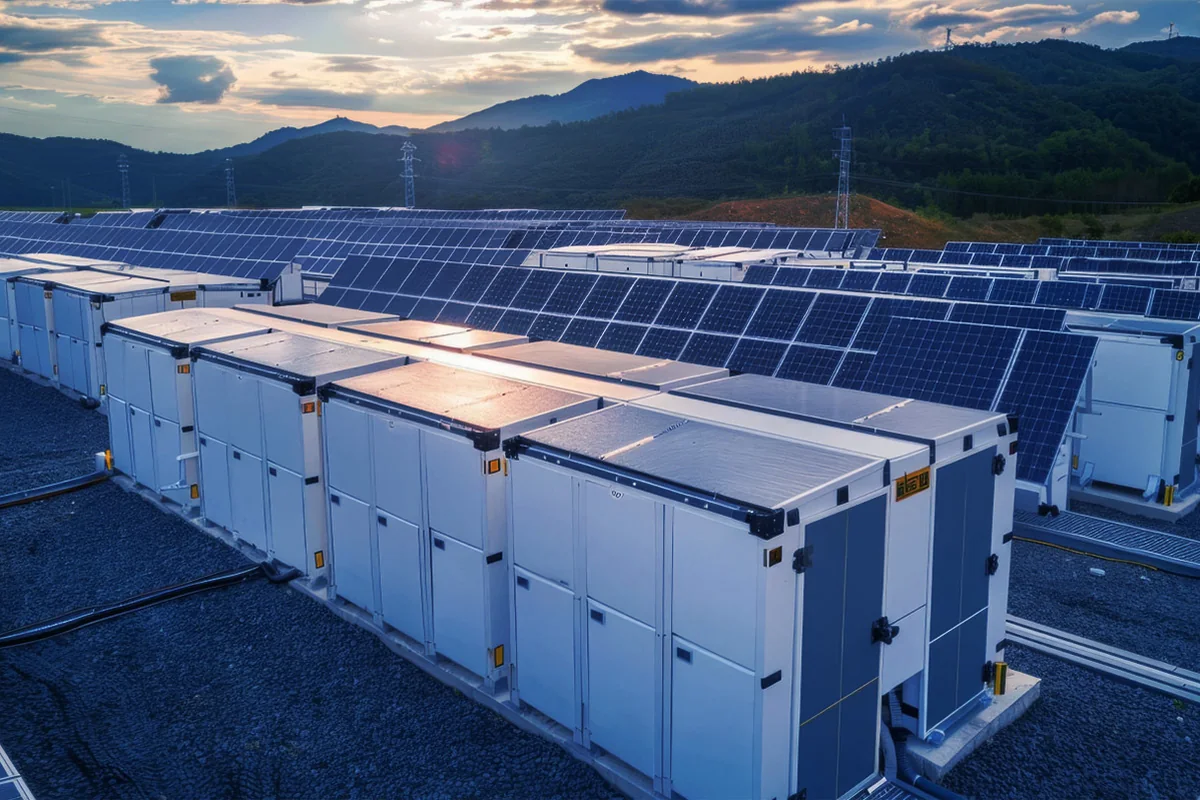
A high temperature power supply decision usually starts with the wrong number. A desert substation inquiry arrives with three numbers that look contradictory: +55 °C outside, 220 V DC required, no grid-tie guarantee. What decides the design is a fourth number nobody writes down — the temperature inside the cabinet, which is 15–20 °C above ambient on an unshaded steel enclosure at midday.
Desert substation cooling: what fails first
- Electrolytic capacitors. Life halves for roughly every 10 °C of core temperature rise. A 105 °C part rated 5000 h at 105 °C is a 20000 h part at 85 °C and a 10000 h part at 95 °C — the difference between a five-year service interval and a two-year one.
- Fan bearings. Standard bearings plus fine sand is an abrasive slurry. When the fan stops, everything upstream of it starts its countdown.
- Filter media. A clogged filter converts an air-cooled design into a passively cooled design with no warning.
- Battery. Heat accelerates grid corrosion and water loss. A lead-acid bank in a hot cabinet can lose half its design life.
Cooling decision logic
| Situation | Wrong answer | Right answer |
|---|---|---|
| Fine conductive sand, no maintenance for 6 months | Filtered forced ventilation | Sealed cabinet with air-to-air heat exchanger |
| Dust is non-conductive, quarterly maintenance possible | Sealed cabinet with no margin | IP54 with labyrinth intakes, oversize filter, differential-pressure indicator |
| Sun-exposed steel cabinet | Larger fans | Sunshade or double-wall construction to cut the internal gradient at source |
| Load varies widely | Single fixed-speed fan | Fan with tacho feedback and temperature-controlled speed |
The pattern is consistent: remove the heat path from the cabinet before adding air movement. Every fan you add in a desert is a maintenance item with a bearing in it — which is why a substation power supply and a 220 V DC power supply for an outdoor cabinet are specified on different cooling logic, and a rugged power supply is not simply a sealed one.
IP65 power supply rating: choose it from the dust, not from the datasheet
IP20 is for a clean technical room. IP31 or IP42 handles falling dust in a sheltered cabinet where the air is filtered. IP54 is the honest minimum for an exposed outdoor enclosure in a sand environment, and it must be paired with a heat path that does not depend on open airflow. IP65 sounds safer and is often worse: fully sealed enclosures trap the heat that then cooks the capacitors.
The 220 V DC system specifics
- N+1 rectifier modules so a single module failure is not a station event.
- Insulation monitoring on both poles — in dry heat, a slow insulation fault is the classic precursor to a DC trip.
- Battery sized on the protection duty cycle at hot-ambient capacity, not on a nominal hour rating.
- Breaker and contactor ratings checked at the cabinet internal temperature, not at 25 °C catalogue values.
Test records should include a thermal image at rated ambient before shipment. If a supplier will not provide one, they have not tested the design at the temperature you are buying it for.
Related: Desert substation configuration · Substation 220 V DC panel specifications